Meditation: What It Is, Benefits, and How to Get Started
Research has shown that meditation offers several health benefits, including better sleep, reduced stress, an increased ability to handle challenging emotions, and greater overall wellbeing.
What is meditation?
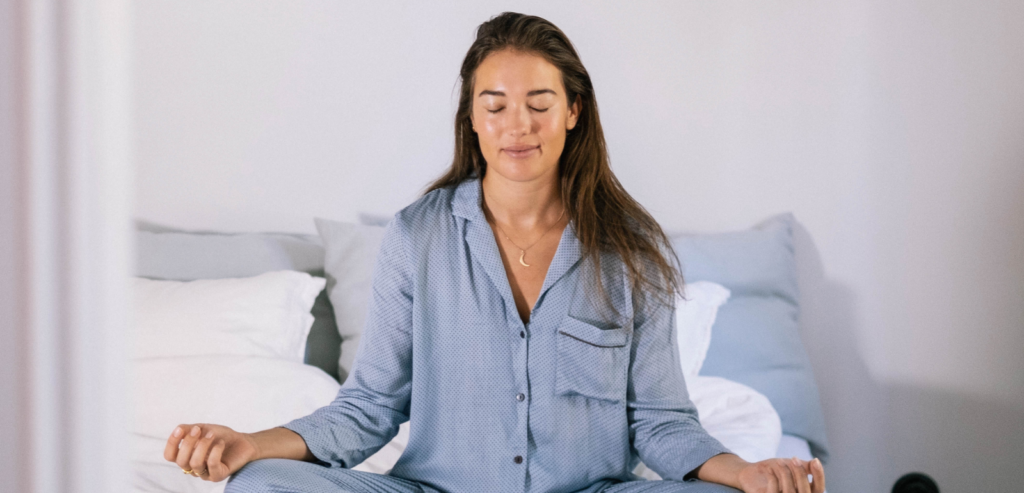
There are many different meditation techniques, but what almost all of them have in common is that they strengthen your ability to be present and aware. It is the ability to keep your attention in the current moment rather than being distracted by thoughts. The instructions for meditation are simple, but it is not always easy.
Meditation & Yoga
Common misconceptions about meditation
- It does not have to be quiet. Many people who try meditation think they have failed every time a thought appears, but that is not the case. One of the most important insights meditation can offer is that we humans have an enormous number of thoughts, most of which we are completely unaware of. Meditation can help us become more aware of our thoughts so we can let go of the ones that are not useful.
- It is not a religion. Although many meditation techniques come from religious traditions such as Buddhism, Hinduism, Christianity, Sikhism, and Islam, there is nothing inherently religious about meditation. It is a universal practice in presence and awareness. When practised honestly, meditation can actually help you question your thoughts and beliefs.
- It does not have to take long. Research has shown that ten minutes of regular meditation produces good results. There are even studies suggesting that three minutes of meditation can make a difference. With that said, most people need to practise meditation regularly to remember to be mindful.
- You do not need to sit in a specific way. Meditation can be practiced anywhere and at any time. It is about keeping your attention in the present moment. For a more formal seated meditation, it can help to find a comfortable position where you feel alert and awake, but this is not required.
Why meditate?
Think back to the best moments of your life. Where are you? What are you doing?
Wherever you were and whatever you were doing, the best moments in our lives seem to share one thing. We are fully present in that moment, without thoughts of the future or the past.
We all share the same desire to be happy. We just have different ways of trying to get there. When we begin to examine what we truly long for, whether it is going on holiday, learning to play an instrument, or earning more money, we often discover that what we are really longing for is presence. We tend to think something needs to happen first for us to be happy, but we miss the fact that it is only in the present moment that we can truly be happy.
Presence is not defined by what we do, but by how we do it. To be present is to fully experience your life. The key to living a present life is awareness. Presence and awareness are two sides of the same coin, often referred to as mindfulness. Awareness means knowing what is happening here and now. It helps us distinguish between thoughts and what is actually happening in reality. It is only when we become aware that we can make wise decisions.
Meditation is the practice of training our attention so we can direct it toward what is most valuable in any given moment.
Benefits of meditation
- Presence — Research has shown that we are lost in thought 47% of the time. Meditation helps us return to the present moment. Each time we bring our attention back, we strengthen our ability to be present..
- Creativity — We often say we “get” an idea rather than make one. Creativity tends to arise when we step away from constant thinking and planning. Meditation can help us access the space where ideas emerge.
- Focus — Concentration is the foundation of meditation. The mind often jumps from one thought to another, sometimes referred to as the “monkey mind.” Meditation helps us strengthen focus and become more productive, which in turn also makes us feel better.
- Wellbeing — Some claim meditation has helped them become 10% happier; others say it has changed their lives. Meditation is a tool that helps us observe ourselves with greater equanimity. Accepting what already is helps us create inner peace and harmony.
- Reduced stress — Stress is the greatest public health challenge of our time, and it is almost always rooted in our thoughts. Meditation is not a relaxation exercise, but it helps us observe our thoughts from a distance and see which ones are valuable and which ones we can let go of. Being able to tell the difference helps us relax.
- Compassion — Research shows that meditation increases compassion. We become more aware of self-critical thoughts and learn not to take them as truth. This helps us be kinder to ourselves and, in turn, to others.
The science of meditation
The brain changes through meditation
From an early age, we are taught that we can and should train physically. If we run, we improve our fitness. When we go to the gym or do push-ups, we get stronger. If we dance, practise yoga, or stretch, the body becomes more flexible. And we do not just become faster, stronger, and more flexible. Physical training also makes us feel better. But many of us were never taught that mental training is possible too. We do not have to remain the way we have always been.
The brain is not static. It is plastic. Neuroscience research has overturned the conventional belief that the brain stops changing when we reach adulthood. It turns out that the brain is constantly changing in response to our experiences. Neuroplasticity, the brain being shaped by repeated experiences, continues from morning to night, an influence we are normally unaware of. The brain can be compared to a muscle that grows stronger with training. This also means it changes when we do not train it. Just as we get more out of breath when we stop doing cardio, our brains and behaviour are affected if we neglect mental training such as meditation.
The myth of multitasking
This is perhaps most evident when it comes to multitasking. Yet the idea that humans can perform two cognitive tasks at the same time remains surprisingly persistent. In one study, Dr. Harold Pashler at the University of California, San Diego found that MBA students at Harvard dropped to the cognitive level of an eight-year-old when attempting to perform two mentally demanding tasks simultaneously.
Meditation strengthens our ability to resist the impulse to do multiple things at once by repeatedly directing attention toward a single conscious focus. When we are fully present with one thing at a time, we do not just become more efficient and productive. We also feel better.
Effects of meditation for beginners
The number of studies on meditation and mindfulness has grown enormously. By 2026, more than 20 000 international studies had been published. In the book Altered Traits, Richard J. Davidson and Daniel Goleman reviewed the research on meditation and mindfulness to better understand what science shows. Their conclusion is that meditation has several positive effects even at an early stage, including for beginners.
A widely reported experience among meditators, though subjective, is reduced stress. This has also been observed in the brain, with reduced stress reactivity in the amygdala, an area closely linked to stress. After just two weeks of practice, attention improves. This includes stronger focus, a reduced tendency for the mind to wander, and improved working memory. One study showed that memory improved so significantly that it had measurable positive effects for people applying to graduate programmes in the United States. However, two weeks of meditation is not enough, as the effects are temporary. Just like physical fitness, mental fitness is perishable.
Temporary states become lasting traits
For those who have meditated for a thousand hours or more, studies show that the positive effects become increasingly stable, and new ones emerge. There are indicators, both in the brain and hormonally, that point to reduced stress activity and lower levels of inflammation in the body. Increased activity in prefrontal areas has also been observed, indicating a greater ability to handle emotional challenges. This means one is less easily drawn into difficult emotions and does not remain in them as long. Studies have also shown reduced levels of the stress hormone cortisol through meditation, suggesting a generally lower reactivity to stress.
The longer we meditate, the more likely it is that temporary states become lasting traits.
Your guide to a more present life
How to get started with meditation
You can learn to meditate at a physical location such as a meditation studio, during a meditation retreat, or one-on-one with a coach or teacher. There are also countless digital resources, including meditation apps, videos, and guided meditation playlists. Or you can try it yourself using the instructions below.
- Find a comfortable position. You do not need to sit cross-legged to meditate. Simply find a comfortable position. A chair works perfectly well. It can help to sit with a straight spine, especially if you tend to fall asleep easily. Relax your body completely while staying as alert and awake as possible. Imagine you are about to listen to a new song by your favourite artist. Your body is relaxed, but your mind is awake enough to catch every melody and lyric
- Direct your attention to your body. The body is always present, and when we are in contact with it, we know our attention is in the here and now. Choose to direct your attention to your breath, a specific part of your body such as your hands, or your whole body. Let your chosen point of contact serve as an anchor to the present moment, somewhere you can always return to if you notice you have become distracted.
- Be as a curious witness. Feel and experience your chosen part of the body. Notice what is happening without evaluating, judging, or criticising. Rather than looking for something to fix, simply observe what is happening, exactly as it is. Curiosity is the key.
- Begin again. Quite quickly, you will likely notice that even though the instructions are simple, it is not easy. Attention tends to wander into thoughts about the future or the past. This is not a failure. It is an important part of meditation. Every time you notice you have been distracted, you are once again present and aware. In this way, you make a kind of mental repetition each time you return to the present, strengthening your presence through meditation.
- Be kind to yourself. The most important moment in meditation is when we realise we have been distracted. That is when we have the opportunity to meet ourselves with kindness. Simply begin again without effort, tension, or self-criticism. Meditation also helps us meet ourselves, and whatever we experience, with greater compassion. Mindfulness asks what is happening in the present moment, and self-compassion asks what we need right now. In meditation, we practise both.

Tips for building a meditation habit
Meditation is not difficult, but building the habit can be challenging. We know a habit has formed when it feels strange to break it, like going to bed without brushing your teeth. It is the same with meditation. Notice with curiosity what happens on a day you do not meditate. Many meditators find that they experience more difficulty because they take their thoughts more seriously, especially thoughts about themselves. In other words, they are less present.
Here are Mindfully’s best tips for meditating regularly:
Self-compassion
In meditation, we don’t only practise becoming more present. We also practise being kinder to ourselves. Every time we get distracted by a thought and begin again without inner criticism, we’re training self-compassion. We can bring the same attitude whenever we’ve planned a meditation but life got in the way. Why not simply begin again tomorrow?
Connect your meditation to an existing activity
Look at your day and see if you can add your meditation alongside something you already do. After making your bed? Before eating lunch? Right when you get home from work? Or perhaps the last thing you do before going to sleep?
Celebrate the times it happens
Research has shown that we can strengthen the likelihood of forming a new habit by attaching a positive feeling to it after completing the activity. Thank yourself for taking the time as a closing moment to your meditation.
Consecutive days can be a fun challenge but aren’t essential
The most important thing for building a habit is not managing to meditate a certain number of days in a row. At some point we’ll all miss a day — we’re human, not robots. What matters most is starting again after a break.
One minute counts
The most important meditation is the one that actually happens. Ten minutes is better than five, but sometimes there just isn’t time. You don’t even need a full minute. Allow everything to be as it is and give your full attention to the present moment. That’s meditation!
Include others in your intention
Reminding yourself why you meditate can help you prioritise it. Maybe you want to feel less stressed, sleep better, or enjoy your morning coffee more? A helpful tip is to also include how it can benefit others, having an intention not just to feel better yourself, but to be more present with the people in your life.
Why not enjoy it?
Meditation can become a gift you give yourself. A moment free of obligations and expectations, where you don’t need to solve any problems or improve yourself. A moment to enjoy being present with yourself, so you can then enjoy being present with others.
Meditation with Mindfully
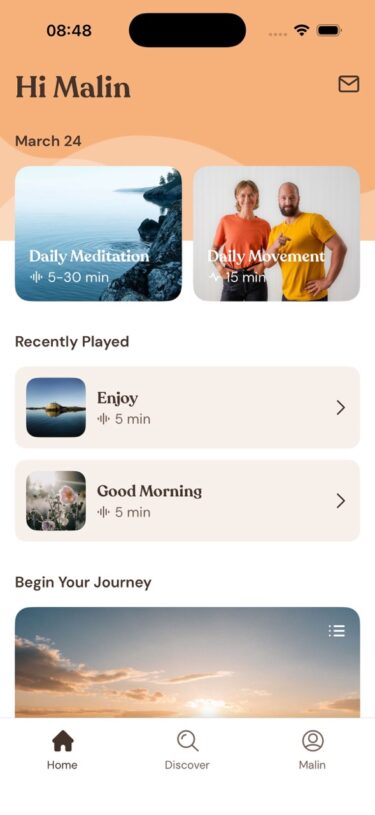
With the Mindfully meditation app, you can learn to meditate and deepen your practice anytime, anywhere. Mindfully offers a wide range of guided meditations, mindful movement, and teachings grounded in both ancient wisdom and modern science. Whether you are new to meditation or have been practising for years, Mindfully supports you in living with greater presence and clarity.
Welcome to your inner journey.